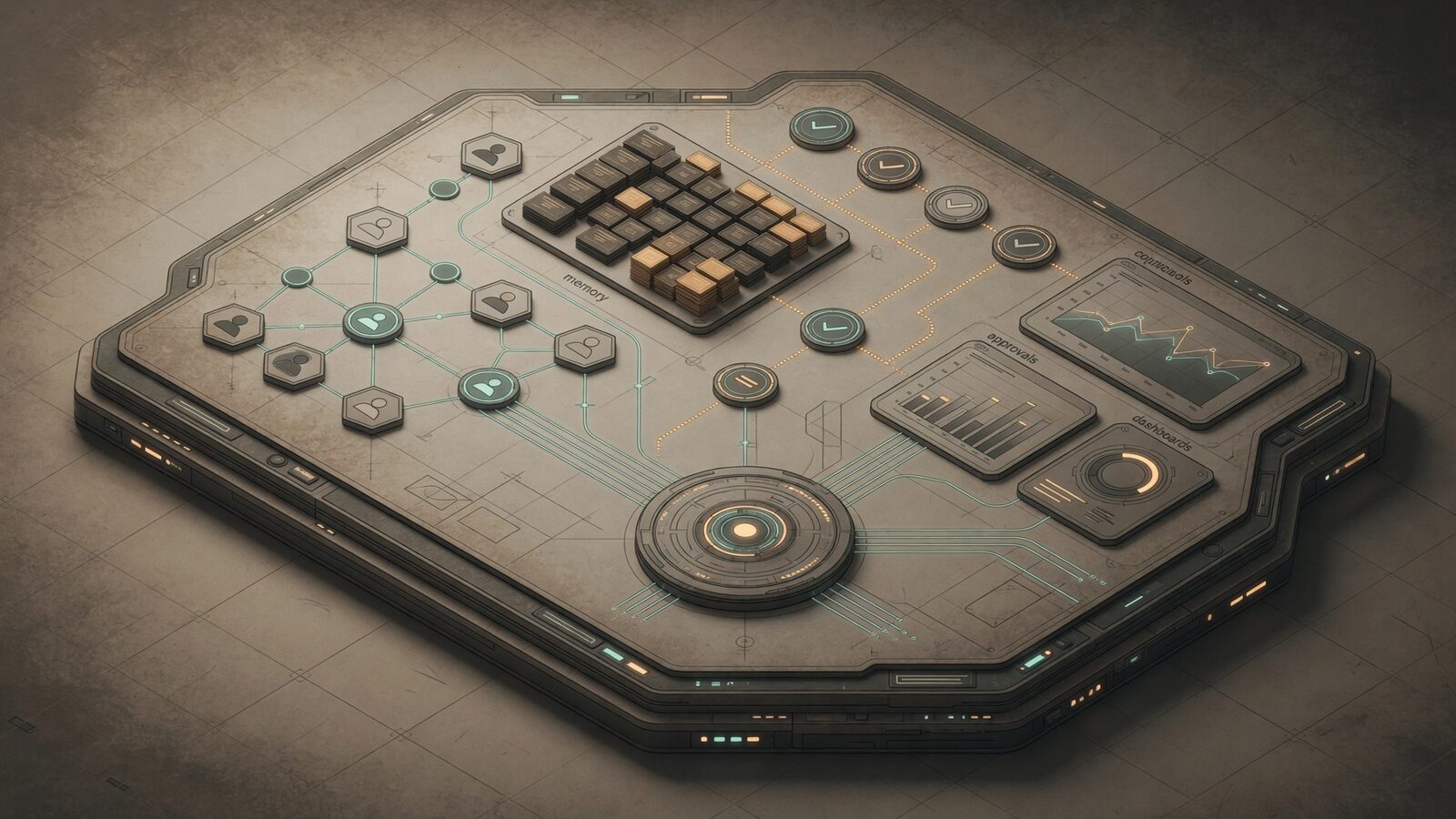
An AI operating system is not a product you buy; it is a way of running your business where a connected team of agents handles the repetitive work end to end, feeding each other and feeding you, while humans focus on judgment and relationships. Think of it less as software and more as the nervous system of a modern small business, the layer that keeps everything moving without you carrying every task by hand.
Key takeaways
- An AI operating system is connected agents running your repetitive work end to end, not a single app.
- The value is in the connections: agents handing work to each other remove you as the middleman.
- Humans stay in charge, doing judgment and relationships and supervising the agents.
- You build it up gradually, one agent at a time, into a system that runs your operation.
- The result is a small business that runs like a bigger one, without the payroll.
Here is what an AI operating system actually means for a small business, and how it differs from just using a few tools. It builds on how to build an AI team.
It is a system, not an app
The phrase trips people up because it sounds like a piece of software to install. It is not. An AI operating system is the way your agents, tools, and people are wired together to run your operation. Just as a computer's operating system quietly coordinates everything running on it, your business's AI operating system coordinates the agents doing your triage, chasing, research, and reporting, so they work as one connected whole rather than scattered parts.
The value lives in the connections
A single agent saves you time on one task. An operating system saves you far more, because the agents hand work to each other. Your research agent preps a call and passes notes to your drafting agent; your note-taker feeds your chaser; your chaser flags a stubborn case to you. The work flows through the system without you copying and pasting between tools or carrying tasks from one step to the next. Removing yourself as the courier is where the real leverage is.
Humans stay at the centre
An AI operating system does not remove you; it centres you on the work that matters. The agents run the describable grind, and you, and any team, do the judgment, the relationships, and the decisions, while supervising the agents and approving anything sensitive. It is a system designed around keeping a human in control, not replacing them. You end up running your business rather than being run by its admin.
You build it up gradually
Nobody installs an AI operating system on day one. You build it the way you would build a team: one agent at a time, starting with your most painful task, proving each before adding the next, and wiring the handoffs as you go. Over a few months, those individual agents connect into something that runs your operation. The operating system is the destination; building one role at a time is the road.
A tangible example: imagine Éabha's business a year on
Imagine Éabha, who a year ago did everything by hand. She started with a triage agent, added a chaser, then a research agent feeding a drafting agent, then a reporting agent tying it together. A year on, her agents run her admin end to end overnight, handing work between themselves and surfacing only what needs her judgment. It is easy to picture Éabha, still a one-person business, operating with the calm and capacity of a small team. That connected setup is her AI operating system, and she built it a role at a time.
How it differs from just using AI tools
Plenty of businesses use AI tools, a writing assistant here, a scheduler there, without having an operating system, because the tools are disconnected islands and the owner still carries work between them. The difference is the wiring. An operating system connects the agents so work flows end to end, whereas scattered tools leave you as the integration layer, manually moving things from one to the next. The same tools, connected deliberately, become a system; left disconnected, they stay a drawer of apps.
Why it matters for a small business
For a small business, an AI operating system is the closest thing to hiring a team without the payroll, the recruitment, or the management overhead. It lets one person, or a handful, produce the output of a much larger operation, because the repetitive work runs itself and the people do only the work that needs people. That is not a far-off vision; it is a setup you can start building this month with a single agent. Judge the whole thing against the return it delivers, and start on the home page.
Why "operating system" is the right metaphor
The operating-system metaphor earns its keep because it captures something a list of tools does not: coordination. A computer's operating system does not do the work of any single program; it manages memory, schedules tasks, and lets applications talk to each other so the whole machine functions as one. Your business's AI operating system plays the same role, coordinating the agents so triage feeds drafting, research feeds calls, and chasing feeds decisions, without you standing in the middle wiring each connection by hand every day. Once you see it this way, the goal stops being "which agents should I buy" and becomes "how should my agents work together," which is the question that actually unlocks the leverage.
Starting small without losing the vision
The apparent paradox of an AI operating system is that you build this coordinated whole by starting with a single, humble agent. That is fine, because the vision guides the sequence even when you are only building one role. If you know you are heading toward a connected system, you choose your first agent partly for how it will later hand off to the next, and you keep the setup tidy and documented so the pieces connect cleanly as you add them. Starting small does not mean losing the plot; it means building deliberately toward a system rather than accumulating disconnected tools. Hold the operating-system picture in mind, build one proven role at a time, and the coordinated whole assembles itself.