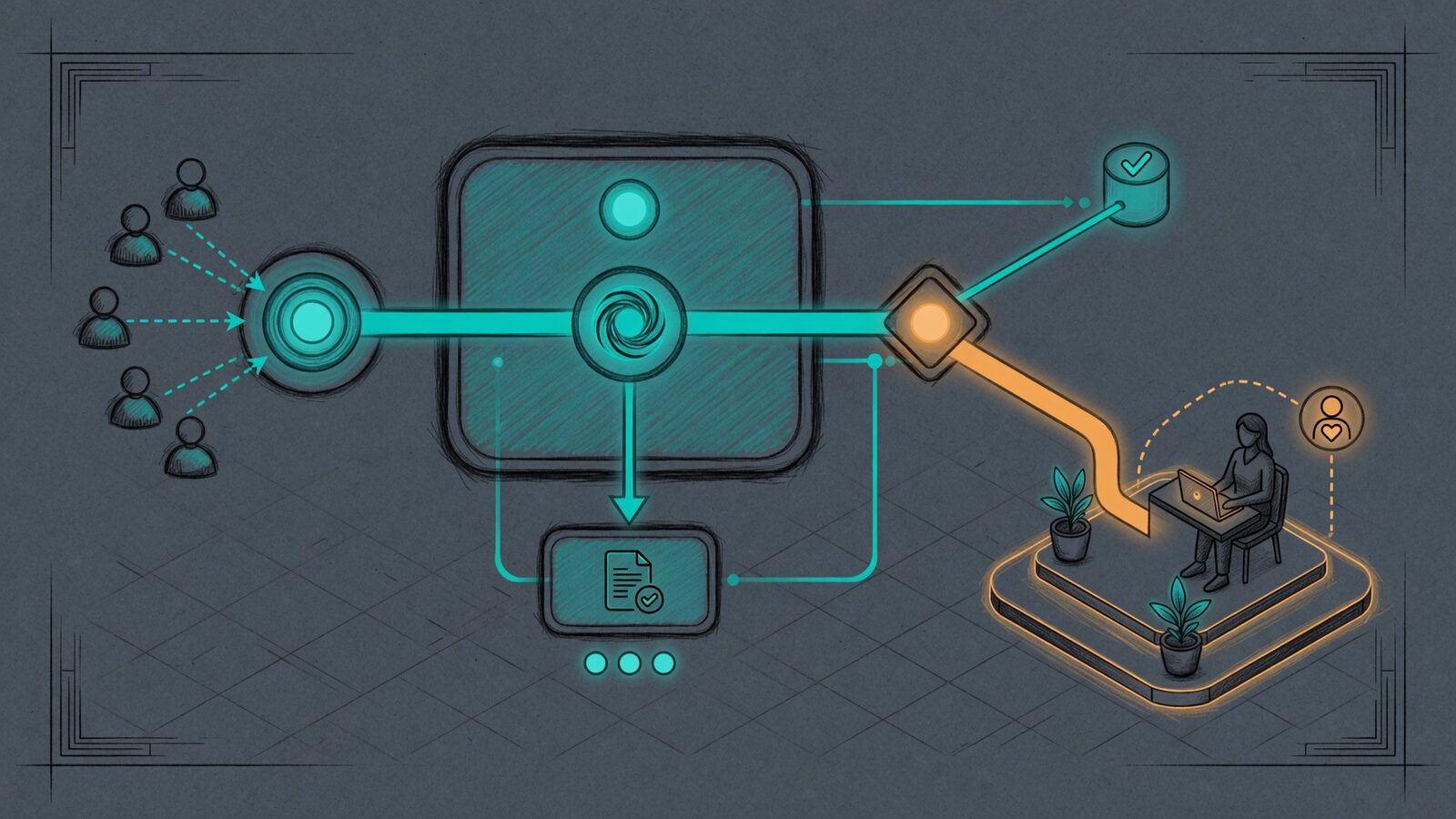
Choosing who helps you put AI into your business matters more than which tools you use, because the wrong partner leaves you dependent, overcharged, or with a glossy strategy and nothing that works. The right one hands you a working system you own and understand. Here are the ten questions that separate the two, and what a good answer sounds like.
Key takeaways
- The partner matters more than the tools; the wrong one leaves you dependent or empty-handed.
- The single most important question is "could I run this without you afterward?"
- Insist on fixed scope, clear deliverables, and ownership in your own accounts.
- A partner who uses agents in their own business beats one who only talks about them.
- Judge on what you walk away owning, not on the size or polish of the pitch.
Here are the ten questions to ask any AI implementation partner before you sign, and how to read their answers. It pairs with the red flags to watch for.
1. Could I run this without you afterward?
The most important question of all. A good partner builds capability into your business so that even if you part ways, you keep running everything. A bad one builds so you always need them. If the answer is vague or the honest truth is no, you are buying a leash, not a system.
2. What exactly will I own at the end?
Ask them to spell out the deliverable: working agents wired to your real tools, in your own accounts, with plain-English documentation. If all you will own is a strategy deck and some logins that live in their account, that is not ownership, and the ongoing fees will reflect it.
3. Is this fixed scope or open-ended?
Open-ended engagements are where budgets quietly balloon. A confident partner will agree exactly what is being built and what it costs before starting. Reluctance to fix scope usually means they are protecting an open-ended invoice rather than your outcome.
4. Do you run AI agents in your own business?
If a partner does not use what they sell, they are guessing. Ask what agents run their own operation. Ones who eat their own cooking give you battle-tested setups; ones who only advise are working from theory.
5. What happens if it takes longer than expected?
On a fixed-price build, overrun is their problem; on open-ended hourly, it is yours. The answer tells you where the risk sits, and a good partner is comfortable carrying it because they are confident in their estimate.
6. How will you keep my data safe and compliant?
A serious partner talks easily about minimising data, choosing providers with proper agreements, EU hosting where it matters, and separating client information. Vagueness here, covered fully in are AI agents GDPR compliant, is a warning sign.
7. Will you document everything in plain English?
Documentation is what lets you keep the system after they leave. Ask to see an example. If they cannot show you clear, non-technical documentation of how things are set up, you will be dependent on their memory, which is another form of the leash.
8. How do you keep a human in control of the output?
A good partner builds in approval on anything sensitive by default, the human in the loop pattern, rather than handing you a fully autonomous black box. This protects your reputation while trust is earned.
9. What does success look like, in numbers?
Ask how you will measure whether the build worked: hours saved, cash recovered, response times. A partner who ties their work to a measurable return, the kind of figure in the ROI of AI agents, is thinking about your outcome, not just their invoice.
10. What is your ongoing role after handover?
There is a big difference between a retainer you choose because it adds value and one you cannot escape. Ask what ongoing support looks like and whether you could walk away. Optional, valuable support is fine; mandatory dependency is not.
A tangible example: imagine Orla comparing partners
Imagine Orla, weighing two partners. One pitches a beautiful strategy phase, open-ended, everything run through their accounts, no clear handover. The other offers a fixed, done-with-you build from around €1,500 a month, documents everything, and hands her ownership within a few months. On paper the first looks more impressive. Run the ten questions and it is easy to see Orla ending up dependent and paying indefinitely with the first, and self-sufficient and cheaper with the second. The questions expose what the pitch hides.
What good answers have in common
Notice the thread running through every good answer: ownership, clarity, and confidence. A partner worth choosing wants you to own the system, will fix the scope and the price, uses agents themselves, documents everything plainly, and is relaxed about you being able to leave. A partner to avoid gets vague on ownership, resists fixing scope, and quietly builds in dependency. The ten questions all test the same underlying thing, whether they are building a capability for you or a habit you cannot break. Start on the home page if you want to ask us these directly.
Why the partner matters more than the platform
Owners often obsess over which AI platform or tool to use, when the far bigger determinant of success is who helps them implement it. The tools are largely commodities; they change, improve, and get cheaper every few months, and a good partner will pick sensible ones and swap them as better options appear. What you cannot easily swap is a bad partner who has left you dependent, undocumented, and locked into their accounts. Choosing well at the partner level protects you regardless of how the tools evolve, because a good partner adapts the tooling for you over time. Fixating on the platform while ignoring these ten questions is optimising the small decision and neglecting the big one.
Take your time and ask them all
There is rarely a good reason to rush this decision, so do not let anyone pressure you into it. Ask all ten questions, listen for the thread of ownership, clarity, and confidence in the answers, and pay attention to how comfortable the partner is being questioned. A partner worth choosing welcomes scrutiny because it showcases their strengths; one to avoid grows defensive because scrutiny threatens the sale. Give yourself permission to walk away from anyone who will not answer these plainly. The half hour it takes to work through them properly can save you months of fees and a dependency you did not want.