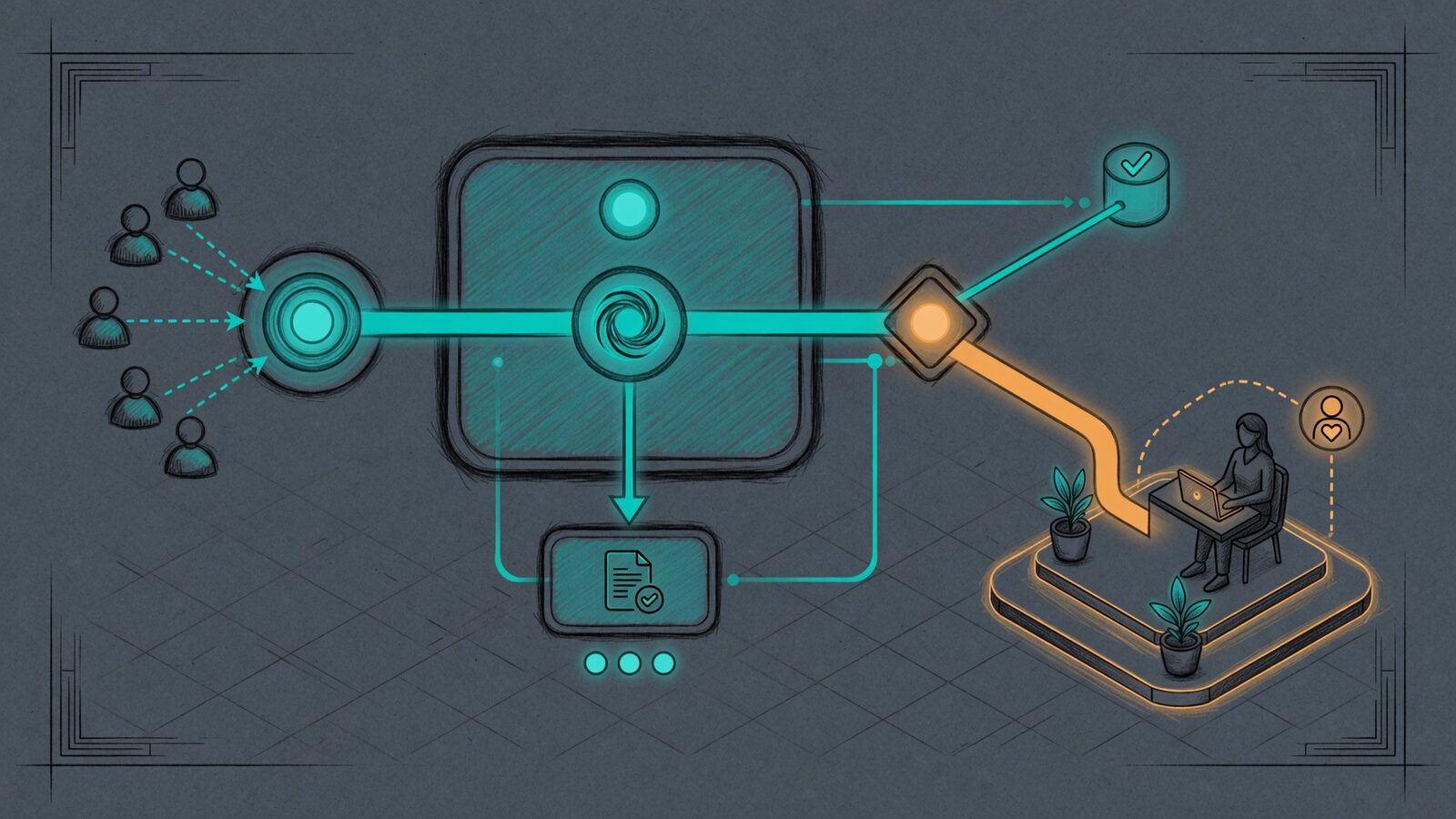
"Done-for-you" is a lovely phrase that hides a lot of variation. With one provider it means a complete, working AI system built, wired, documented, and handed over. With another it means a strategy deck and a wish of luck. Before you pay for done-for-you, you need to know exactly what lands in your hands at the end. Here is what a real one includes.
Key takeaways
- "Done-for-you" varies wildly; insist on knowing exactly what you receive.
- A real one includes discovery, building, wiring to your tools, documentation, and handover.
- You should end up owning working agents in your own accounts, not renting access.
- The best versions still teach you enough to run it, so you are not dependent.
- Compare done-for-you against DIY and done-with-you before assuming it is the right fit.
Here is what proper done-for-you AI implementation actually covers, stage by stage. It sits within the wider DIY versus done-with-you versus done-for-you picture.
Stage 1: Discovery and task mapping
It starts with understanding your business, not with tools. A good provider maps your week, finds the describable, repeatable tasks eating your time, and decides which to hand to agents first, essentially the work of an AI readiness audit. Skipping this stage is how people end up automating the wrong things impressively.
Stage 2: Building the agents
Then the actual construction: writing each agent a clear role, its instructions, its rules, what it must never do, and when it should ask you first. This is where done-for-you earns its name, because getting agent instructions right is fiddly, and having someone experienced do it saves you the learning curve entirely.
Stage 3: Wiring to your real tools
An agent is only useful when connected to the tools you actually use, your inbox, your calendar, your CRM, your accounting system. A real done-for-you build handles these integrations so the agents work inside your live setup, not in a demo. Integration is often the most fiddly part, and it is exactly what you are paying to not have to do.
Stage 4: Testing and human-in-the-loop setup
Before anything runs freely, it should be tested and set to draft for approval on anything sensitive, the human in the loop default. A good provider proves each agent on real work, tunes it, and only widens its permissions once it is reliable. You should never be handed an untested, fully autonomous system.
Stage 5: Documentation and handover
This is the stage that separates real done-for-you from a dependency trap. You should receive plain-English documentation of how everything is set up, with the agents running in your own accounts, not the provider's. Handover means you could keep the whole thing running if the provider vanished tomorrow. Without it, "done-for-you" quietly becomes "dependent-on-them."
Stage 6: A little training so you are not helpless
The best done-for-you does not leave you as a passenger in your own business. It includes enough teaching that you understand what the agents do, how to approve their work, and how to ask for changes. You do not need to become technical, but you should never be so in the dark that any small change requires paying the provider again.
A tangible example: imagine Bláthnaid's build
Imagine Bláthnaid, a busy solicitor with no time to build agents herself. She chooses a proper done-for-you engagement. The provider maps her admin, builds a triage agent, a chasing agent, and a document-prep agent, wires them to her real systems, tests them in draft mode, then hands them over documented and in her own accounts, with an afternoon of training. It is easy to picture Bláthnaid getting a working AI setup without touching the build, yet still owning and understanding it. That is done-for-you as it should be.
What it should not include
A real done-for-you does not include a leash. It should not leave the agents running in the provider's accounts, hidden behind their logins, or undocumented so that you cannot function without them. It should not be a strategy document dressed up as an implementation. And it should not lock you into a mandatory retainer you cannot escape. If any of those appear, you are looking at dependency wearing a done-for-you label, which is the opposite of the independence the phrase promises.
Is done-for-you right for you?
Done-for-you suits people whose time is scarce and who would rather pay to skip the build entirely, provided they still end up owning the result. If you have the time and interest to build it yourself, DIY is cheaper; if you want to learn while building, done-with-you is the middle path. The honest recommendation is to compare all three before assuming done-for-you is the answer, and above all to insist that whichever you choose leaves you owning a working system. Start on the home page to talk it through.
Questions to ask before buying done-for-you
Before you pay for anything labelled done-for-you, pin down a few things in writing. Ask exactly what you will own at the end and whose accounts the agents will run in, yours or theirs. Ask whether you will receive plain-English documentation and some training. Ask whether the price is fixed and what happens if the build overruns. And ask the decisive question, whether you could keep everything running if you parted ways. The answers separate a genuine done-for-you build that leaves you self-sufficient from a dependency dressed up in a reassuring phrase. A good provider welcomes every one of these questions because their honest answers are selling points.
Done-for-you is not set-and-forget
One misconception worth correcting is that done-for-you means you can hand it over and never think about it again. Even the best build needs light ongoing attention, your business changes, integrations occasionally break, and instructions drift out of date. A good provider either includes sensible maintenance or teaches you the ten-minute monthly check that keeps everything healthy. Done-for-you removes the build burden, not the responsibility of running a business that now has agents in it. Understanding that upfront stops you feeling let down later and helps you choose a provider whose handover genuinely leaves you able to maintain the system yourself.