The dream of the solo business has always run into the same wall: there is only one of you, and admin eats the hours you meant to spend on real work. AI agents move that wall. By handing the repetitive work to a small team of agents, a single person can produce the output of a much larger operation, keeping the freedom of working alone while losing the ceiling that came with it.
Key takeaways
- A one-person business is capped by hours; agents lift the cap by running the repetitive work.
- Build a small team of agents for triage, chasing, research, drafting, and reporting.
- Keep the judgment, relationships, and decisions, the reasons clients chose you, for yourself.
- Start with one agent on your worst task, prove it, then add the next, into a connected system.
- The result is the output of a team with the freedom, and margins, of working solo.
Here is how to run a one-person business with the output of ten, without hiring anyone. It builds on how to build an AI team.
The solo trap: you are the bottleneck
When you work alone, every task routes through you, the selling, the doing, the invoicing, the chasing, the admin. The valuable work competes for hours with the drudgery, and the drudgery usually wins because it is urgent. That is the ceiling: not your ability, but your available hours. Break the link between your hours and the repetitive work, and the ceiling moves dramatically, because the constraint was never your talent.
Build a small team of agents
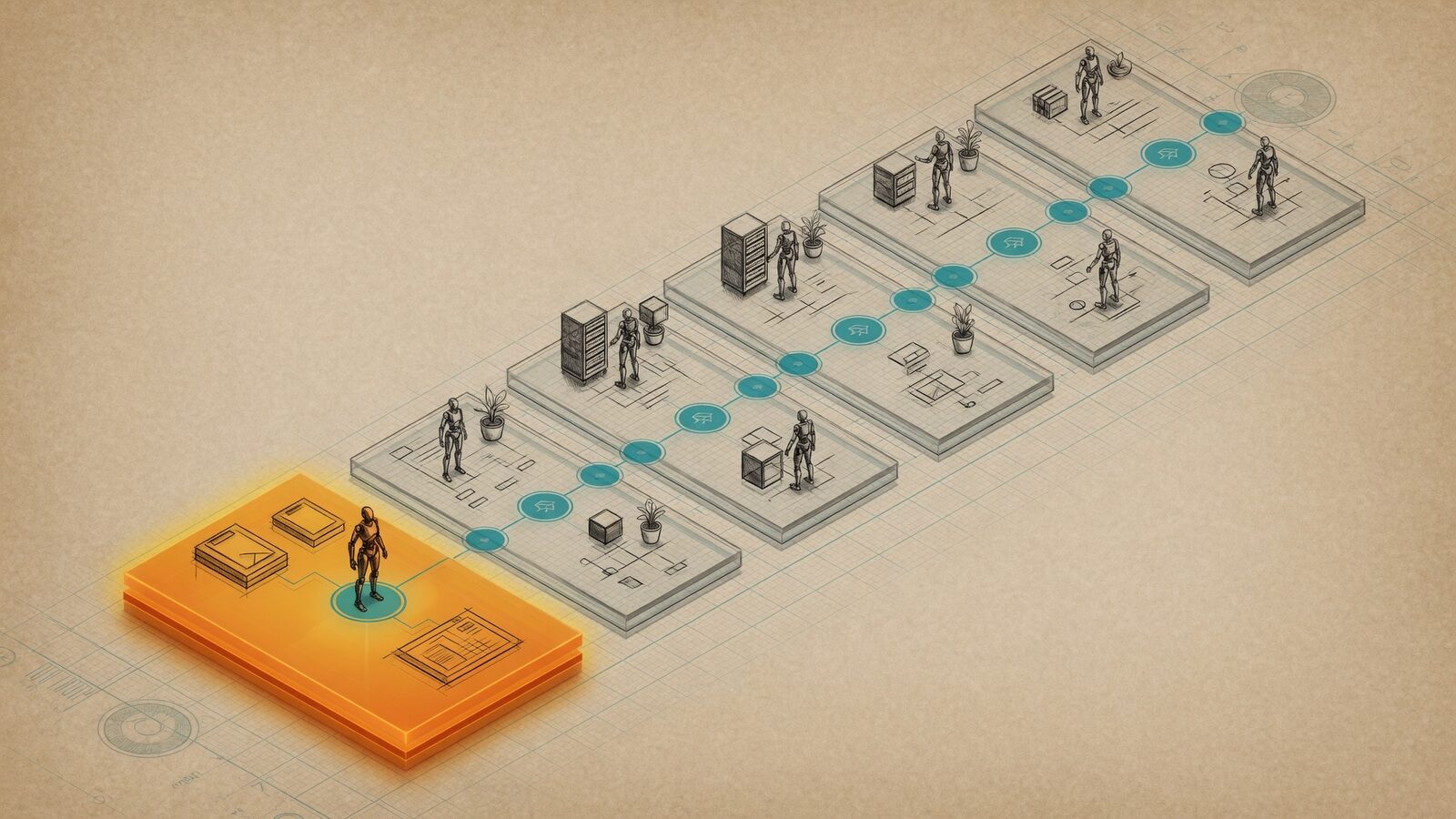
The move is to hire agents instead of people, one describable role at a time. A triage agent to run your inbox. A chasing agent to pursue invoices and leads. A research agent to prep your work. A drafting agent to write first passes in your voice. A reporting agent to keep your numbers current. Each takes a slice of the drudgery off your plate, and together they form the team you could never afford to employ, for a few hundred euro a month.
Keep the valuable work yours
The point is not to automate yourself away; it is to automate everything that was never the point. The judgment clients pay for, the relationships that win the work, the decisions only you can make, these stay firmly yours, and now they get your full attention because the admin no longer competes for it. You become more present in the work that matters, not less, which is usually what made you go solo in the first place.
Wire the agents together
The leap from a few tools to the output of ten comes from connecting the agents so they hand work to each other. Your research agent preps a lead and passes it to your drafting agent; your note-taker feeds your chaser; your reporting agent pulls from all of them. Once the work flows between agents without you carrying it, you stop being the courier between tasks, and that is where a solo operator suddenly performs like a team. This connected setup is your AI operating system.
Build it up gradually
You do not stand this up overnight. Start with the single task that steals the most time or causes the most stress, build one agent for it, and prove it over a fortnight in draft mode, keeping a human in the loop on anything sensitive. Once it is reliable, add the next role. Over a few months, the agents connect into a system that runs your operation while you run your business. Slow and proven beats fast and fragile every time.
A tangible example: imagine Maeve going solo-plus-agents
Imagine Maeve, a solo consultant who was turning down work because admin capped her at a handful of clients. She builds agents over three months: triage, then chasing, then research feeding a drafting agent, then reporting. By month four the admin runs itself overnight and Maeve spends her days on client work and selling. It is easy to picture her doubling her client load without hiring or working longer hours, because the ceiling that held her was drudgery, and the agents took it. She is still one person, now producing like a small firm.
The freedom, without the ceiling
This is the real prize of a one-person business run with agents: you keep everything good about working alone, the freedom, the low overheads, the margins, and lose the thing that always held it back, the cap on your hours. You are not managing staff, carrying payroll, or diluting your control; you are directing a team of agents that never tire, do not need managing in the human sense, and run the work you never wanted to do anyway. Judge the whole thing against the return it delivers, or start on the home page.
What "output of ten" really means
The phrase is not hyperbole if you look at where a solo operator's time actually goes. Studies of small-business owners consistently find that a large share of the working week disappears into administration, coordination, and low-value tasks rather than the core work or selling. If agents absorb most of that share, the hours you free are not marginal, they are a substantial multiple of what you had available for real work before. That is the mechanism behind "output of ten": not that you personally do ten people's work, but that removing the drudgery unlocks so much of your capped time that your effective output rises to something a small team would have produced. The multiplier comes from reclaiming hours that were never spent on value in the first place.
Common worries, and why they fade
Solo owners hesitate for a few predictable reasons, and each softens on inspection. "I will lose control" fades once you see agents draft for your approval on anything sensitive, leaving you more in control of the important work, not less. "It will feel impersonal" fades once you keep every relationship and judgment yourself, with agents only handling the admin clients never saw. "It is too complex for one person" fades once you build a single agent at a time rather than everything at once. And "I cannot afford it" fades against a cost of a few hundred euro a month for output a hire could never match at that price. The worries are real but they do not survive contact with how this actually works.